Owned project
Corevio, demonstrated by its own website.
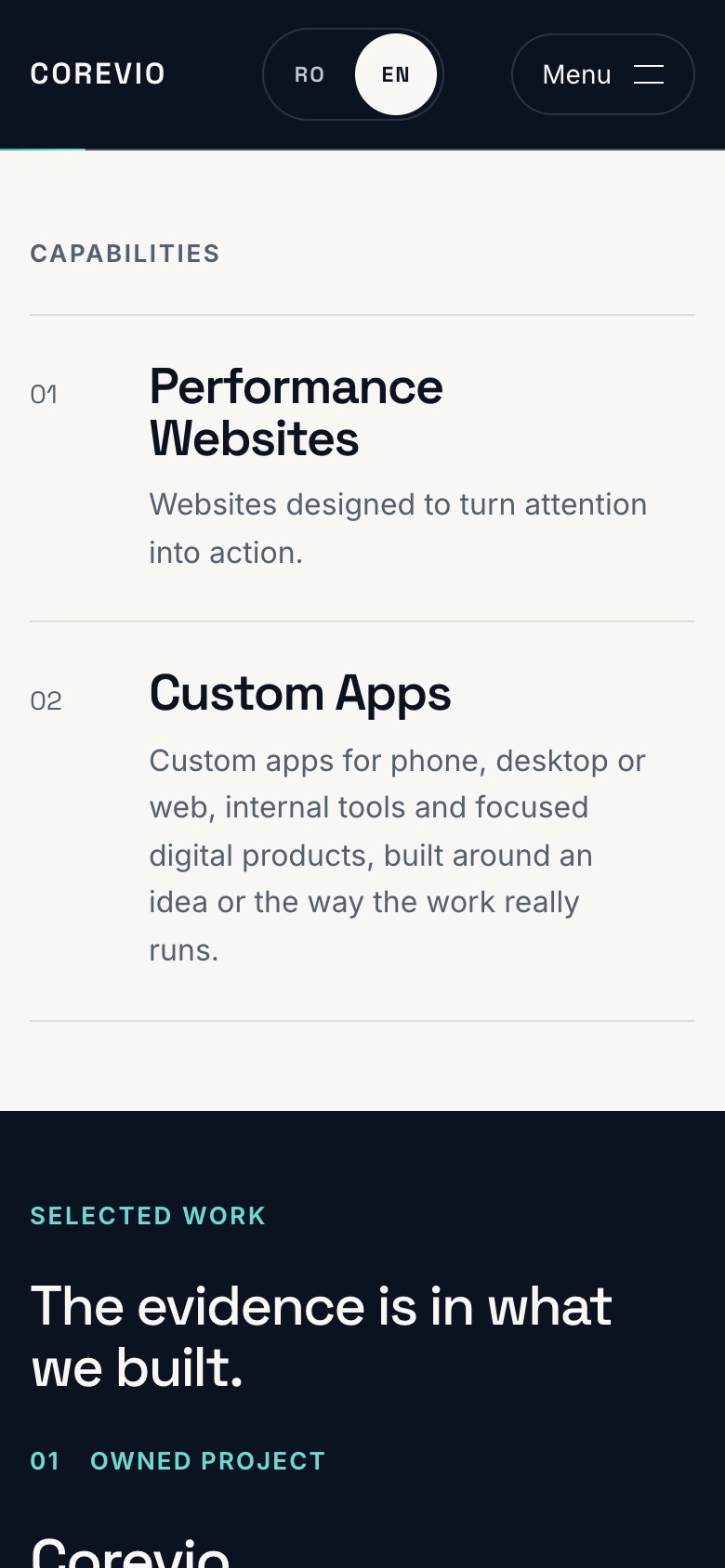
The Corevio website itself, built as proof of how we work.
The problem
Whoever builds performance websites should be judged by their own.
A website is the first proof of seriousness a visitor sees. Corevio started from the reverse question: what should a visitor be able to verify without taking our word for it?
What we built
A website built as a product, not as a brochure.
Structure, hierarchy and language are decided in code, not by convention: one central route map, typed content in two languages and a suite of checks that runs before every merge.
Outcome
Delivered, not promised.
A complete bilingual website that can be verified directly. We report no commercial results or performance figures: no measurements have been published, and results will appear only after verification, with a date and a scope.
The experience
An experience that shows the idea instead of describing it.
Motion and interaction exist only where they explain something.
- 01
One continuous opening
The homepage moves from the promise to the capabilities and then to real work as one continuous experience, rather than a stack of disconnected sections.
- 02
Selected work as one sequence
Corevio, ROST 26 and DentiJoy are presented as one continuous body of work, using intact product interfaces rather than decorative mock-ups.
- 03
The same experience without motion
Reduced-motion, no-JavaScript and constrained-screen fallbacks preserve the same content, hierarchy and path through the page.
- 04
Motion-safe by design
The opening scene respects reduced-motion preferences and falls back to the same content and hierarchy when motion or JavaScript is unavailable.
- 05
One accessible reading path
The animated scene keeps a single semantic heading structure and prevents its duplicated visual text layer from entering the keyboard or assistive-technology reading order.
Engineering and evidence
What we can stand behind, and what it rests on.
Each statement below matches a source checked in the project. What was not measured is not claimed.
Architecture
One central map defines every page in both languages, with localized metadata, canonical, hreflang and x-default. Unknown addresses get a real 404 in the right language.
Automated checks
Automated tests walk every route in Romanian and English: document language, the language switcher, SEO, internal links and mixed-language text.
Automated checks
Axe checks run on representative pages in both languages. They cover machine-detectable issues only and do not replace human review.
Automated checks
Checks from 320 px up to desktop confirm that pages never overflow the screen width.
Feature
The opening scene respects the reduced-motion preference and shows the same content and hierarchy when motion or JavaScript is unavailable.
Automated checks
The animated scene keeps a single semantic heading structure, and its duplicated visual text layer stays out of the keyboard and assistive-technology reading order.
Architecture
Next.js 16, React 19 and TypeScript. The only runtime dependencies are Next.js, React and React DOM.
Specification
Every change has its own branch, deterministic validation and a human approval before it is merged.
Next project
ROST 26
An iPhone and macOS app that shows how much you can safely spend.
Next step
Have a problem that deserves to be understood before it is estimated?
We begin with the real situation, not with a feature list.
Get started